Tuesday, January 7, 2014

Follow the Prophet

When there is a song with this many verses (and we are just doing 6 of them) I like to spread the learning out over a few months.  So we are going to learn one verse each month leading up to May and then we'll pick up the extra verse during May.    We are adding the verse about President Monson that goes like this:

Thomas is a prophet
With a gentle heart.
Visiting the sick,
He always does his part.
Servant from his youth -
He will lead us well.
Listen to his stories,
Live by what they tell.

One of the reasons that we all like this song so much is that it is so rhythmic.  I used the rhythm pattern of the words "Follow the Prophet" to create a drum part for this song.  Once the children know one verse they are ready for drumming!

There are activities that we do in the Primary Room that will NEVER carry over into the chapel for our program.  I think it is still good to do them.  You need reasons to sing songs multiple times so that the children know the words well.  I prefer to use musical reasons to repeat songs wherever I can so I like using drumming with the children.

I always teach the rhythm of a percussion instrument with body movement before using the actual instruments.  It allows me see and identify which children are capable of playing successfully.  It gives all of the children something to do.  It challenges the children to do double thinking as we put movement together with a song.  Here is the rhythm notation for this song.  The pattern is Short Long Short Long Long.

Jr. Primary 

Step 1:  We begin by patting the pattern on our lap.  Get the teachers involved with you.  The adults are usually good at music and help keep the kids on the pattern.  Start slowly and then build up some speed as soon as you can see the children doing it.  

Step 2:  The children keep doing the beat while saying the ABCs.  Can they do 2 things at the same time?

Step 3:  Sing one verse of Follow the Prophet while patting the rhythm.

Step 4:  Children take turns playing this rhythm on drums while you sing the song.  For the younger children they can hold the drum under left arm while using soft drum mallet with right hand.  Reverse this for lefties.

Sr. Primary

Step 1:  Older children are capable of playing a drum with 2 hands so we learn this pattern by chanting the words Left Right Right Left Right while patting that pattern on our laps.  (Note the two Rights in a row.  This allows that the pattern will always be the same and that you won't be alternating which hand you start with.) Of course you are saying the left and right words to the pattern of  Short Long Short Long Long.  You will have to practice this ahead of time and know it well before you try this with the children.

Step 2:  The children keep doing the beat while saying the ABCs.  Can they do 2 things at the same time?

Step 3:  Sing one verse of Follow the Prophet while patting the rhythm.

Step 4:  Children take turns playing this rhythm on drums while you sing the song.  For two handed drumming the drum is held between the knees so that both hands are free to play.  

CODA ( THE ENDING)

Once your children have got this down, you can add an ending to the drumming.  The Coda adds a sense of completion to the music.

Here is what we do for the ending.  Play the drum pattern you already learned 2 times.   Then play Short Short Short Short Short Short Long.  And then conclude with the original drum pattern played once more only with an accent on the last beat!  

Children love adding endings to any song.  An ending is officially called the Coda.  They like knowing they are playing a Coda.  It sounds so important!  Here is the rhythm notation for this Coda.

I will do a post about making drums soon.

Monday, January 6, 2014

He Sent His Son Bell Descant

Since we made a couple sets of the pipe chimes I like to use them whenever there is a nice song that would sound good with a little descant.  This is much more difficult than just having the children in groups playing chords.  However, I use musical icons which makes the teaching much easier.

Children who do not read music can understand musical icons because they are very logical.  The children can SEE how long a note is and also HOW the music moves upward and downward.

Senior Primary could do this easily.  My Junior Primary will also be able to do it but it will take longer.  You have to decide how much time you want to invest in these "extra" activities.  I would use the CTR 6 & 7 classes on the bells.

I have attached the actual music in two forms:  piano and bell part together, and then the bell part separately. Beneath those you will find the iconic pictures.  They are numbered.  You can cut each page along the blue line and then put them in order on your board for the children to see.

Just a note about long notes and pipe chimes.  There is no way for that little pipe to sustain a sound very long but the children won't really notice that.  The point is that the yellow icons are 3 beats long while the red icons are one beat and those move quickly.  They will have to pay careful attention if they are playing on the red notes.  There are two fermatas that the children can learn as you play this song.  I colored that second icon that gets a fermata green to make it stand out from the other icons.


Also note that on page 3 of the icons at the bottom right side there is the word REST.  The piano plays for one measure here while the bells rest.


Roll the Dice

I made dice today with the names of the classes on them.  One die for Jr. Primary and another for Sr. Primary.  Will use them when I want the kids to sing a song multiple times.  I have that particular class come up to the front to sing.  Takes an extra few seconds but gives the kids a chance to be out of their seats and moving which is always a plus for those kids who need that.


I just used cardboard squares and taped them together to form a box for the dice.  Then covered them with paper.  Here are my name labels if you care to use them.  I added the "Teachers" for Jr. Primary because I needed one more name for that die.  I added "Boys" and "Girls" to Sr. Primary because I needed two more names for that die.


Sunday, January 5, 2014

He Sent His Son Introduction

He Sent His Son

To introduce the song, first ask the children the following questions to help them think about how parents teach their children.  I want to focus on the meaning of this song because it is central to the Gospel and is quite profound. I want to help the children connect to these questions in a personal way by letting them reflect on how they talk about these kinds of topics as a family.

The bonus of having this kind of discussion with the children is that they will actually remember the words of the song easier because it will now be very meaningful to them.
______________________________________________________________________________

Most of the time in our families we are busy with school and homework, activities, sports, music lessons, and the many things we do.  But sometimes we sit down together and talk about some of the really meaningful things in life.  You may do this at your Family Home Evenings or around the dinner table during a Sunday meal. 

1.  What do your parents do to teach you they love you and all the other sweet kinds of feelings like kindness, tenderness and caring? 
2.  What do your parents do to teach you how to make good choices and follow a good path in life?
3.  How do your parents teach you about the hard things that happen in life - when someone dies, when someone has an accident, about making sacrifices to help another person?
4.  What is it that your parents expect you to be or to become?  What kind of a person do they want you to be?

Transition to our song:  Heavenly Father loves us very much and wants to teach us those same things.  He chose a very special way to teach us.  It is the most special thing that has ever happened in the whole history of the earth. 

Here are some questions about Him.  What do you think the answers are?

How could the Father tell the world of love and tenderness?
How could the Father show the world the pathway we should go?
How could the Father tell the world of sacrifice, of death?
What does the Father ask of us?  What do the scriptures say?

Always accept the children's answers and respond to them as they share.  Then when you are done listening to their responses show them the answers from the song.

You can go to Sugar Doodle to get visuals to help you with this.  I particularly like this one by Jolly Jenn:  http://www.jollyjenn.com/HeSentHisSon.pdf


Saturday, January 4, 2014

In a Grove of Trees

This is another welcome/wiggle song for Junior Primary.  I wanted something to celebrate the Restoration. We act it out as we sing it:

In a grove of trees:  hands raised, fingers extended for leaves
On a bright spring day:  hand form circle to represent the sun
Young Joseph knelt to pray:  children kneel with arms folded
He saw the Father and the Son:  hand over eyes as if looking up
And he also heard them say:  hand cupped behind ear as if listening

It's time:  we do one hand up with the other above it forming a "T"
to restore my church again:  two hands form roof of church
The promised day:  right hand extends forward
has come:  left hand joins right hand extended forward.

Try to do the movement right on the beat with the music.

After the kids know the song well, try singing it a bit faster.  It's hard to do the actions quickly and they enjoy trying to do it.  They usually do better than I do.

Game:  this can be played as a game where you send someone into the hall while you hide a Book of Mormon or a picture of the Gold Plates somewhere in the room.  They are brought back in and have to find it.  The children sing the song softly if the person is far away from the hidden object and louder as they get close to it.  Nice way to celebrate that the Restoration brought back the Book of Mormon.


It's Time to Go to Church

I have felt the need for a little more variety for wiggle songs for when the Jr. Primary arrives.  I wrote this one because it lends itself to actions.  We start with everyone kneeling by their chair, arms folded with head laid on it and eyes closed.  We are all asleep.  I grab a chair and do it with the kids.  The rest you can make up any way you want.


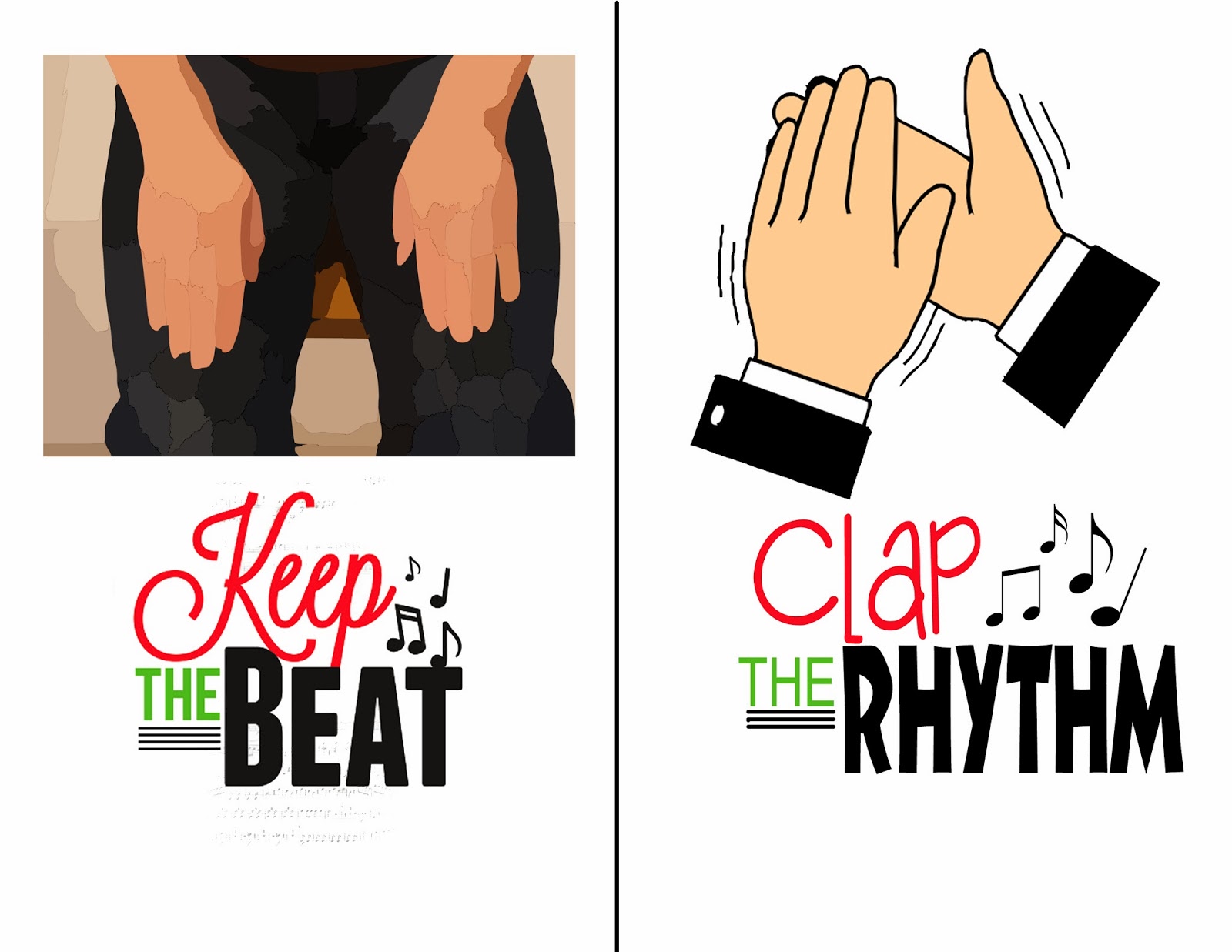
Keep the Beat and Clap the Rhythm

One activity that works well when teaching a new song is to sing the song while keeping a steady beat with your hands and then contrast that to clapping the rhythm of the words.  You have to be sure they understand the difference and can do each separately and then can switch back and forth as they sing the song.

Once the children can do both activities easily, you can then have half of the children keep the beat while the other half does the rhythm.

Senior Primary is capable of keeping the steady beat with their feet while clapping the rhythm with their hands.  They respond well to a challenge.  As you keep them challenged with difficult musical activities they will love singing time.

Beat:  for the younger children it is easiest to have both hands do the same thing so they can pat their lap with two hand to keep the beat.  Older children can "walk" their hands on their lap to the beat of the music, alternating right and left.

Rhythm:  for this activity we are using the pattern of short and long sounds made up by the words of the song.  Clap every syllable of every word to the exact pattern formed by the music to create the "rhythm of the words".

Here are my two signs I use with the children.  I like to go to the paint store and purchase paint stirring sticks to attach to my signs but this is certainly not necessary.